Saturday, 28 April 2012

Memoirs of an Imaginary Friend - Matthew Green


Product DetailsMax is eight. He is probably somewhere at the lower end of the autistic scale, but wherever that is, his parents know that something is not quite right. His Dad wants him to grow up and play baseball, and watch Rambo films, and his Mom just wants him to be happy. He has no friends....... STOP! He does have a friend, a friend who is nearly six years old, called Budo; and Budo, along with hundreds of thousands of others in existence at this moment, is Max's imaginary friend. Yes, that's right, there are others, and Budo meets several of them. Some are clever, some are not, and they all have one thing in common - they exist exactly as they have been imagined. Big, small, heroic, stupid; whatever their imaginers imagined - here they are.

Although about a small boy, this book, narrated by Budo himself, is not a children's book. But it will give you an insight into chidren's minds - the secret places that they cannot tell you about, which is why some of them invent imaginary friends, and why some of them hang around for a long time. And sometimes, they get to look out for a child who is in great danger. Max is in danger, and only Budo can save him.

Matthew Green (in the UK, Dicks in the USA) has pulled off an extraordinary feat of fiction. He has given life to a friend that a child has invented - so much so that I loved Budo as much as any character I have read about. Matthew Green is a teacher, in New England, and somehow I know that he loves his job, loves kids and must be an inspiration to the kids he teaches. And he may not be trained as one, but what a philosopher he is. Whilst reading this book I was asked to believe in imaginary people, to consider life after death(or not), to consider how loss affects us all. I read Memoirs of an Imaginary Friend in 24 hours, getting up at 6.30 am this morning to finish the last 50 pages. Jodi Picoult says "You've never read a book like this before", and whether you are a fan of hers or not, that is certainly true. What I am however, is a fan of Matthew Green - forever, because of this moving story, which let me inside the mind of a child.
 
[copy of my Amazon review]

Thursday, 26 April 2012

Spring comes and brings a worry for next Winter

"I think we had better call the papers" said Willie, "for some big ones are knocking down our Winter shelter, and they are not our big ones, but some big ones with very nasty instruments of torture - quick, put your hands over your ears!   Eeeeek!  that is hurting my ears!"  What was hurting Willie's ears was an industrial grinder, but you wouldn't expect a woodmouse to know that.  The big ones in the house where Shermouse Holmes lived in the garden were taking down an old garage, the very garage that lots of the woodmice sheltered in every winter, for it was warm and dry.  This could be a real problem next year - where would they go to get out of the storms?  All that remained now was the hard concrete floor, no camping chairs to nibble on, no boxes to shelter in, and really, no hope at all for next Winter.  "I am going to call Mr Cheeeeeek at the Daily Fieldwhiskers", said Willie, "mousepeople need to know!"

Copyright SusanMaclean


Friday, 20 April 2012

Alice's Tulips - Sandra Dallas

Product DetailsDecember, 1862, and Alice's husband of one year, Charlie, has gone off to fight the Confederates at the beginning of the American Civil war leaving Alice with Mother Bullock, Charlie's mother.  She's only 20, and just does not know how she is going to bear it all.  She's strong-willed, and says what she thinks, which does not endear her to her mother-in-law - but you have to do the best you can in these circumstances.
Told in the first person, and entirely by letters to her much loved sister Lizzie, we soon build up a picture of small town Iowa, those women left behind, and their reactions to every damned thing that happens.  Gossip is rife, and this will certainly ensure that Alice falls foul of most of the town, especially when a local man is found dead.  How Alice keeps going with her head held high,  nurses her mother-on-law through illness, and does other acts of kindness are described in the letters without an ounce of conceit (well, perhaps a little, she does like pretty clothes and she is opinionated!).  She and Lizzie obviously discuss sex too in their letters, it's not described, but referred to, including the result of a coupling with her husband that Lizzie can't cope with, having two very small children already....
Not hard to read, with chapter headings giving a little potted history of quilt patterns; this is not only a tale of hope over desperation, but a little gem containing snippets of the history of that time stitched into the quilts the quilting group make to send to soldiers. 
 

Saturday, 14 April 2012

The Book Thief - Marcus Zusak


How are you with books that tell you things you didn't want to know, books that (just) might make you cry, books told by Death?  Death is the narrator of this tale, and as he will tell you himself, he was kept very busy indeed in Europe during World War Two, gathering the souls of the dead.  But d'you know what?  Death has a heart.  He gathers the souls very gently, and even though he's busy all the time, sometimes the living, left behind, affect him more than they should.

The Book Thief is, I think, a tremendous achievement.  Set near Munich, Germany, It's the story of Liesel, a child of around 10, who arrives, with her mother, at the home of a strange couple indeed.  And then, her mother walks away. Mama - the new (step)mother, swears like a trouper, has a temper, and cooks badly.  Papa, the new stepfather, plays the accordion and smokes all the time.  Liesel can't run away, she has nowhere to run to, and it is never clear why this happened, and indeed, whether she had a father in the first place; but she has been lodged there for her own safety, that you can be sure of.    She goes to school, she makes friends - especially Rudy, who falls for her the moment he meets her, but never does get that kiss he craves.  They go scrumping apples together, they go stealing together, and they watch groups of Jews marching (or more often stumbling) to Dachau.  As the war progresses, you will find out how people back from the Russian front dealt with their losses, how people who were poor even before the war deal with no livelihood and no food, and how older people were "encouraged" to take on jobs which although not as soldiers, certainly involved wearing uniforms, all the while under the shadow of the swastika whether or not they even supported the Nazi party.  And who was going to say they didn't?

The author is Australian, but second generation European, and he has used events related by his parents as the starting block for this tremendous book.

For those of us who were on the "winning" side of World War Two, this book is a smack round the ears, to remind us that no-one wins a war.  Politically there is a victor, but everyone is a loser,  whether they loose their life, their families, their home, their mind, their friends.  This book will tell you what it's like to be bombed, but it will not take sides.  This book will tell you how different people cope with the same adversity.  This book will make you realise that people are people the world over, and when Death comes, he does not see the country you are faithful to, the colour of your skin, the church or temple you worship at. But to remind you - Death has a heart, and sometimes it nearly breaks.

Saturday, 10 March 2012

Miss Buncle's Book - DE Stevenson

Miss Buncle's Book  written in the 1930s, and certainly has a style of that time -which I really enjoyed.  A real comedy of manners, for when the worst behaved in the village recognise themselves in Barbara Buncle's book, they become even more badly behaved!

Barbara Buncle is a single woman living in a small village.  She doesn't work, indeed she can afford a maid, Dorcas, until her investments and therefore her income, take a dive.  What to do? She was never trained to do anything very much, and there had always been just enough money to live on until now.  Her decision to write a book has interesting results.  She bases the book on Silverstream, her own village, and writes very truthfully about everyone, just changing their names (and not very well, either!).  The most odious woman in the village recognises herself straight away, and threatens to sue - but who?  The author on the cover of the book is John Smith, and who can that be?  A witch hunt starts, with the threat of  a good horsewhipping due to John Smith, if only he can be found.  The accusations fly, and still no-one realises that Miss Buncle is John Smith, even though she has told one of her friends already!

This is really a story of good (and bad) manners, and even though it is rather dated now, there will always be  places where people are not quite what they seem and will take steps to cover their stories up, and where people bluff and blunder when they know they are in the wrong.  For the same reasons that Jane Austen still sells well, any book that manages to describe people as they really are is worth a read.

This lovely book is published by Persephone Books.


Thursday, 23 February 2012

Blow on a Dead Man's Embers - Mari Strachan

I lived in South Wales for three years early in my marriage.... and the feel of the village in which Non, her husband Davey and her three stepchildren live is there, on the printed page.  The Welshness of the speech patterns seems just so right, and so too are the descriptions of the characters, making me think, during the early part of the book, of Dylan Thomas's Under Milk Wood. 

But whilst Milk Wood might amuse, this book has serious subjects to concentrate on.  The returning soldiers who were described as "shell-shocked" then, were actually suffering post traumatic stress -  but no-one knew how to deal with them.  Davey is one such.  He's a coffin maker and carpenter, and appears normal to everyone except Non, who sees him, early every morning, under the kitchen table reliving a certain time in the trenches.  Their marriage is physically over - he has told her that he had an affair with a nurse whilst in a hospital recovering from wounds - although as a father and provider he is still present.  But Non, with her weak heart since birth, is still only 29.  Must this be the rest of her life?  She wants Davey back - but how to do that?

The descriptions of every character, from the minor,  her youngest step-son Osian (what might be described as an idiot savant now),   her lying and jealous mother in law Catherine, and the nosey next door neighbour with constant bowel troubles, to the major - her husband Davey, her friend Lizzy German, and of course herself, Non,  make them come alive.  I couldn't put it down - and although its not a thriller it has several mysteries satisfyingly cleared up as the story progresses.  Also cleverly woven into the story are women's voting rights; the early Labour movement in Wales; the Irish uprising, and the business of how women took care of business whilst men were away at war. 

I loved her first novel "The Earth Hums in E Flat", which had a touch of magic realism about it, and the major character was a child; and I love this one too.  A Welsh writer to be proud of - and to read!

Wednesday, 22 February 2012

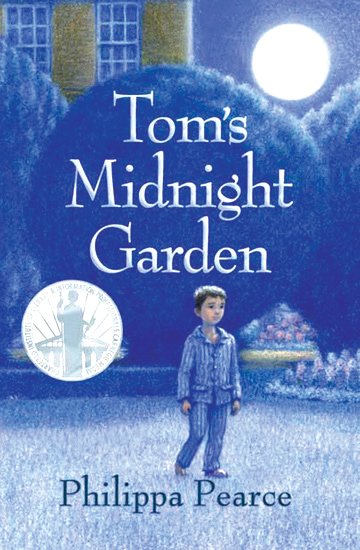
Tom's Midnight Garden - Philippa Pearce

 Tom's Midnight Garden What a lovely, lovely story.  Carnagie Medal Winner in 1958, it's year of publication, this has been in print in some form or another ever since.  I wish I had a child I could read this to - or a child who would read it and enjoy it as I have just done.  Tom's brother Peter has gone down with measles, and it is decided that Tom should be sent off to stay with his aunt and uncle.  What a disappointment for him - its the beginning of the holidays, and the brothers had so much planned.  So off he goes to a tiny flat in a big house with no garden, and no-one to play with (in any case, he is being kept away from people in case he is developing measles himself).  There is no inspiration for him now, the flat looks out onto new houses, there is only a communal yard for the dustbins, and, well, its basically very boring indeed.  Until, one night, he hears the grandfather clock in the communal hall strike 13, and a great adventure begins.
Can ghosts go back in time and visit the past?  or is the past a ghostly time?  Don't be frightened - just go along with Tom and visit the garden of the big house every night when the clock strikes 13, meet Hatty, the most wonderful little girl and playmate, and like Tom, try to imagine some way of stopping time altogether.

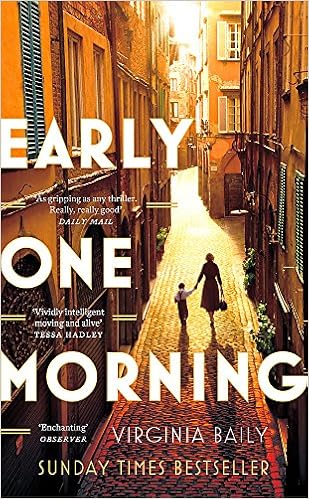
Early One Morning - Virginia Baily

I was attracted to this novel purely by the cover (as I suppose this is meant to happen!) and it has very little about the contents on the b...