Friday, 18 January 2013

Rhubarb - I have had this year's first pickings!

...... and let me just tell you how delicious the lovely pink stems of this ancient plant are. Palest pink forced rhurbarb -just the best!  Chopped into chunks and stewed with a couple of tablespoons of water and a little sugar, just until they are soft, and served still slightly warm with a dollop of plain yoghurt, topped off with a little sprinkle of demerara sugar is our preference.  But but you can put it in a pie, under a crumble, make it into ice-cream or sorbet, replace apples with it in a cake, put it into muffins.  It's the thick stem of a plant, but just treat it as fruit. 

Map of the Rhubard TriangleThe Rhubarb Triangle is an area of West Yorkshire farms bordered by Leeds, Wakefield and Bradford. The forcing  technique was developed in the 1870s and the growers guarded the secret of their sheds jealously when, in their heyday, they produced 90% of the world's winter rhubarb.  The workers pick rhubarb by candlelight (you think I am joking, right?) and in the nursery sheds the silence is so complete they say you can actually hear the rhubarb growing and the air is filled with the sounds of buds opening and developing into stalks.

It was first used as medicine - the first written record of it's use was recorded four thousand years ago!  But it didn't arrive in Britain until the 13th century, when it was four times more expensive than opium.    Gradually it started to be used for food and has been around ever since, going into decline after WW2 when other fruit from far flung lands arrived and was deemed far more exciting, everyone having consumed far too much of the stuff during the war when there was little else.

But it's time has come again, and it's lovely sharp flavour is finding favour..... 90% goes straight to supermarkets.  If you haven't ever tasted it, give it a go - it's like nothing else, especially in cold days of winter.

PS - don't eat the leaves ever, they contain the poison oxalic acid.


Thursday, 17 January 2013

Auntie Mame - Patrick Dennis

Patrick is a child of 10 when his father, the surviving parent, dies.  He is passed to his father's sister, the Auntie Mame of the title, for guardianship, love, affection, and upbringing (although it will come as a great shock to him as to the manner of it all).  Mame is a larger than life character.   She has money (which ebbs and flows, depending on her fortunes or who she is married to at the time) and loves company.  Parties?  the woman invented them!  His father's lawyer, who is overseeing his life and his investments until he is of age, has, following a long and difficult meeting with Mame, arranged for him to attend a "good" boarding school; and on each visit home he's treated like the prodigal son.  But of course, whilst this book whisks through Patrick's life from school, to army life, to marriage over a course of around 20 years ( It's set during the 1920's 30's and 40s), it is really about the Auntie Mame!  She falls in and out of love at the drop of a hat, she picks up trends and goes with them, she enlarges Patrick's vocabulary no end.  She takes on the accent and lifestyle of her lovers, too, and this makes for some really funny scenes.  I really thought the writing style was a delight - it made me want to keep reading just another chapter just to see what Mame would cook up next!
A warning though, one of the chapters is about a character who makes some nasty anti-semetic remarks during a heated dinner party ( the book was first published in 1955), but the very manner of Mame's put-down of that character is worthy of a very loud cheer.

I started the book under the delusion that it was non fiction, and a friend said not necessarily, and she was right - in a way.  Patrick Dennis was a pen name - a pen name for someone with an even larger life than Mame, but I won't spoil it for you except to say that if you are in anyway interested about real people's lives, please don't leave out the Afterward in the book (the Penguin Modern Classics edition with pink cover)  - which explains and enlightens. It spurred me on to research and read about the real Patrick Dennis too - there is a biography (Uncle Mame:  The Life of Patrick Dennis by Eric Myers), which I think is definitely worth following up, and an old film, with Rosalind Russell in the title role to look out for.   And there really was an Aunt - not Mame, but Marion - but Mame is just so worth getting to know.  I can't imagine how this book passed me by for so many years.

Tuesday, 15 January 2013

Cooking for Claudine - John Baxter

Product Details
John Baxter is Australian, and he's married to a French woman.  That makes Claudine, his mother-in-law French too.   And yes, he lives in France - although he's also spent time in America and in Britain.  Being  a journalist, a film maker and a cook, he has a great view of life, a taste for the good things in that life (family, food, wine) and a talent for cooking - how fortunate!  However, the French are conservative about food, particularly those who have always lived in rural France, and running through this book is the story of one Christmas dinner - the one where the roast suckling pig became a Cajun (and thus Arcadian) meal, covered in spices (spices?!) and bathed in Guinness.  On Christmas day he has to perform surgery on the pig in order to get it to fit into the oven, and here he is giving instructions over the phone by a surgeon.  He finds two cases of glorious wine in a village shop and is surprised to find that the locals won't pay the price of 10.25 Euros per bottle - although he does!  There are many smiles on the pages, and some laugh out loud moments too, and as well as that, this is a book to share - either by reading out loud, or by giving as a present to someone who loves food and wine.  But don't worry because, even if they are not a Francophile, a foodie or a wine lover, this is an entertaining read, which left me smiling.

Saturday, 12 January 2013

The affair of the bloodstained egg cosy; The affair of the mutilated mink and The affair of the thirty-nine cufflinks - James Anderson

These three "golden age of crime" novels are great fun, and sadly there are no more, as Anderson died in 2007.  Don't let that put you off if you have never tried them, but do try to read them in order, as little snippets from earlier stories do get mentioned in the second and third.

Rather like Agatha Christie's crime novels, these are set in the 1930s, and all of them have the same address - Alderley, a large country pile in the southern counties of England, home to the Earl of Burford, his wife, and his sparky daughter Geraldine, who strives to solve crimes before the police, and sometimes gets in harms way because of that!  They are, despite the murders, lighthearted, and full of characters who may or may not have committed a crime, and the reader is always led a merry dance until Chief Inspector Wilkins solves the crime, announcing it in the same way as Ms Christie, by having all the suspects in the room at the same time whilst telling each character how he has deduced that they cannot have committed the crime before telling the criminal that he/she has committed it, and how.

Quick to read, short chapters and nothing to tax the brain (except trying to spot the criminal of course!), but great for a big read on a rainy day or to take on holiday.

Wednesday, 9 January 2013

Tell me...... is this good business practice?

On Sunday, a party of us are dining out as we usually do in January, exchanging presents because we normally do not see each other between the beginning of December, and the beginning of January each year.  This party involves one elderly lady who loves to come out with us and meet all her younger friends.

Two days ago, I booked a table for 7 at a gastro-pub.  This morning I hooked up with 2 other friends who we had thought might not be able to come and they said "yes please!".  Now, all I have to do is phone the pub and ask if I can bring 2 extra diners.  The immediate answer I got was, "No, you can't".

I asked if I could fit two more chairs round the original table but was told no, as it was a tight squeeze already.  Mmmmm.  "I don't want to cancel the booking, I would like you, The XXX Arms, to have my business....... can you help?"  "No, Sunday is our busiest day, and we are already nearly fully booked".

Now at this stage, you might think that I would just cancel and go.  But the elderly friend was really looking forward to eating at this particular venue, it having been closed for a while, re-opening only last Summer, so you will understand that I pressed on..........
ME "Do you perhaps have a table for 2 available?"
THEM  "Yes, but you do understand that you will not be near the original table?"
ME  "Yes, but I presume it will be in the same room so we will be able to wave at each other!"
THEM "Yeeees...." 
ME "I'll take it" etc.

Now I have a dilemma.  I really want to talk to the management about this.  I should not have to tell staff how to handle a customer and keep their business (perhaps an offer of two tables, one for 4 and one for 5 would have been the way to go).  I also know that as we get older, our basket of common sense is brimming over with good ideas.  But if I tell the management how this was handled, it is the girl who answered the phone who will be in the soup, when in fact I see a gap in staff training here which is clearly management's fault.  What would you do?

EDITED TO SAY ..... yes I did phone them.  I asked for the Dining Room manager, and explained my dilemma.  He understood, he would sort this out before we got there, and he took my point about staff training.  We arrived on Sunday, and everything was as it should be, two tables next to each other - one for 5 or 6 and one for four, which they then offered to join up.  We took that offer and had a lovely lunch with very attentive staff, and enjoyed our annual meet up.  I have learned that it was the right thing to do, to bring this problem to their attention, and they have learnt that a happy customer is a tipping customer!  Win-win!

Winter's Bone - Daniel Woodrell


Some years ago, when George Bush Senior was President of America, I remember seeing a news item of a train journey through the Appalacian Mountains giving out sweets and presents around Christmas-time.  I thought then that surely, surely, there could not be that kind of poverty in the USA?  On reading this book, that thought came back to me.

A short book, full of beautiful sentences, about an ugly subject.  And don't bother if you only like light reading, or love stories, or travel adventure; this is a heavy subject.  Ree Dolly, a   teenage girl responsible since the disappearance of her Pa  for two small brothers and a mentally ill mother,  has to prove that her father is dead or the house will be repossessed.  Given that there is nothing on the floor, only tinned spaghetti in the larder and that she has only a long dead grandmother's winter coat to keep out the cold, you can see where this is going.  There is love, but it's certainly not love of extended family, and travel only involves driving unmade country roads in the Ozark Hills of Missouri (mostly at night) looking for clues.  Violent? yes, in part.  Drugs?  well, most of the extended family are hooked on the kind of drugs that Pa had a reputation for making.

Ree's father is a drug chef.  That's how he makes his money despite the fact that their land is covered in old, huge trees that would make them a fortune if they cleared and sold some.  Can't be done.  A great grandfather said the trees were always to stay, so the drugs are cooked, and Pa has already served one long stint in jail.  As the story opens, he has left home and promises to be back real soon.  When the local sheriff tells Ree that her father put up the house and land as a bond (like bail in the UK) when recently arrested, her heart hits her boots.  For there is nothing she can do to raise the kind of money needed to pay that bond if her father does not turn up on the required day for a court appearance.  Who will look after Ma, and the two boys?  And gone too is her dream about leaving all of this poverty behind and joining the army, where you get paid to follow orders, they give you clothes to wear and food in your belly.

Ree needs to find Pa, and quickly.  Everyone she talks to is either related to, or at permanent war with, her side of the family, but whoever she talks to, she's warned off.  With her friend Gail, the mother of a new baby at the wheel of an elderly pick-up truck, she drives the locality, talking and seeking the truth.

It's very black indeed.  It's violent, you can feel the poverty, you can smell it, but you are rooting for Ree all the time.  Daniel Woodrell is a wordsmith and no mistake.  He makes you feel it all, the good and the bad, so wonderfully descriptive is his writing.  How is it that this is the first of his books I have come across?  Come on, let's get him better read!


Monday, 7 January 2013

When someone disappears.......an internet conundrum

As a member and moderator of a UK website, sometimes things occur to me when I'm doing housework on the site.  I want to close down a thread tonight as we have a new one of the same subject for 2013.  Whilst looking around, I noticed that one of our regular members had not posted for a while, and when I looked up the "last visit", it was August 2012. Mmmmm.  Just before Christmas, one of our regular and respected members had died, but we knew straight away because there had obviously been instructions left about "what to do if........"

And it set me to thinking.  What do you do if someone just disappears?  Maybe they want to stop using that particular site?  Maybe a family happening has meant that they have no time for the internet?  Maybe, like Nan of "Letters from a Hill Farm" blog, they have just decided to stop? (although to be fair, Nan did tell all her followers that she was stopping blogging).

If, like our particular website, the friends you have are real (because we meet up in groups all over the country regularly, and have made some lovely friendships because of it), it is a worry when someone is just not there.  What do you do?  You can send them an email if you have an email address - but what if you haven't?  What if you have got their email address but never get a reply?  Are they dead or just ignoring you?

This must have happened many times in the internet world, but what are people actually doing about it?  Is it that under normal circumstances the person concerned is not "real" so it doesn't really matter?  Surely not!

In pre-internet (and possibly pre-phone) days, the executor of an estate would not only clear out the house, pay outstanding bills, forward gifts to those named, sell property if any, and generally tidy up the estate of the deceased - they would also put an advertisement in the local paper to say that Joe Bloggs died after a long illness etc.  If people had moved from their home town then it would also be necessary to go through the address book if there was one, sending a note to everyone in it.  Then phones arrived, and the executor might sit down and ring round.  And then with the arrival of mobile (cell) phones, presumably, lots of people get to hear by text. 

But now we have something new.  The death or disappearance if an internet friend.  So this may be something you will want to think about?  Who is going to do the "what to do ...." list after you have gone? and where are your internet details?  

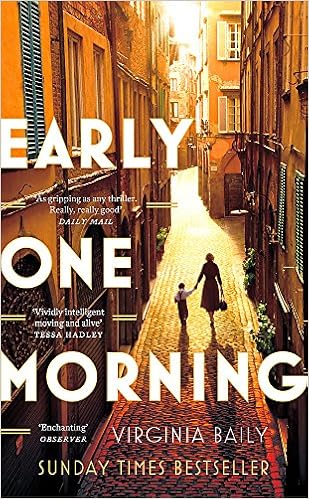
Early One Morning - Virginia Baily

I was attracted to this novel purely by the cover (as I suppose this is meant to happen!) and it has very little about the contents on the b...