E M Almedingen was born and privately educated in St. Petersburg (now Leningrad), Russia. She asked permission to leave the country and arrived in London in 1923 with sixpence in her pocket. She was a medieval scholar, and I found this at a book warehouse for £1. Love those serandipidous finds!
If you know nothing of the Hansiatic League (or Hansa), here's a tiny bit of information from Wikipedia: The League was a commercial and defensive confederation of merchant guilds and their market towns that dominated trade along the coast of Northern Europe. It stretched from the Baltic to the North Sea and inland during the Late Middle Ages and early modern period (c. 13th to 17th centuries).
The League was created to protect economic interests and diplomatic
privileges in the cities and countries and along the trade routes the
merchants visited. The Hanseatic cities had their own legal system and furnished their own armies for mutual protection and aid.
Sabrina is the only child of a Hansa merchant, a dealer in cloth, in
Europe at the time of the Wars of the Roses in England. His house (the Stephen's Light of the title) is the biggest in the city, for it also includes the "shop" -although that is really a room for trading, rather than the shop as we know it today. Sabrina has been educated by nuns, and is now betrothed to a travelling trader from the French town of Troyes - the betrothal arranged by her father. Just two weeks before the marriage is due to take place, he absconds with a young nun from the convent across the water - the very convent where Sabrina was educated.
Without marriage to look forward to, the only other place for an unmarried daughter is the convent, except the nuns turn down her father's request to take his daughter (the family are not nobility, merely trade), and so Sabrina asks her father if she may learn the family business instead. Grudgingly it seems, he agrees, to the confusion of her mother who cannot contemplate the girl sitting in the counting house alongside her father. But it is not long before she shows her true mettle, wheeling and dealing for better prices with the best of them. Meanwhile, on the island across the water, the internal politics of the nuns proves a real eye opener! Convents at that time in that part of the world were peopled by rich women, unmarried women who were sisters and daughters of titled persons, who brought huge dowrys with them. They dressed in expensive cloth, they had their own lapdogs, they wore religous but huge stone-studded jewelry, and they were constantly using the law to up their income by suing for one reason or another any one they thought had slighted them. They ate better than the peasantry too, rich foods as befit their station. Interesting concept.
Sabrina does learn the business, and when her father dies suddenly, after a stroke at breakfast one day, she finds herself having to call on inner strengths and take on the business completely, Something new to the town and the League; but not altogether new, as Hansa members had certainly heard of women merchants in the City of Bristol, England, including one Alice Chester, who with her son had done so well that she had a huge shop with a hall above it. How she digs deep to stop the city rabble attacking the nuns on the island, and how she comes to terms with her life makes a fascinating historical novel - written back in the 1950s to suit young adults. It is rather old fashioned, but worth the reading for all that.
Mac-Adventures (with books! I read an eclectic mix of books, some years old, rarely prizewinners, sometimes on bestseller lists but more than likely not: but the ones I like I'll tell you about...... if you read them too, let me know! You may also find Gardening here, Home and Furniture makeovers; sometimes Food, Travel tales..... but mostly, Books.
Sunday, 4 January 2015
Thursday, 1 January 2015
Provincial Daughter - R M Dashwood
I picked this off the shelves at the end of December - wanted something light that could be picked up and put down at random. We had several "callers-in" just prior to Christmas, my sister was here as a house guest for a week, and then on 30 December we were off to take her home and then on to a supper party nearby with friends, sleeping over and coming home on 31 December. So I really did read up to the wire on this one, finishing it around 7.30 pm on New Year's Eve.
R M Dashwood was the daughter of E M Delafield, author of The Diary of a Provincial Lady and the books that followed it. Dashwood says that it was intended as "an equally light-hearted continuation..." of the Provincial Lady books - "...the Provincial Lady's daughter in the nineteen fifties". Originally published in 1951, it was republished as a Virago Modern Classic in 2002. And I'm glad, because it was a delight to read.
The nameless writer of the diary with doctor husband Lee, and three charming but dirty, messy and cheeky boys (just like anyone else's kids, I guess!) struggles with never enough housekeeping money, new clothes for the children, idiosincratic husband, friends who are always better dressed than she. Also the worry of a thickening waist - just like us all, in that she thinks she is fatter than she was (even though clothes that are years old still fit, thank goodness!); the search for the husband's dress shirt eventually found in a bag in the bottom of the wardrobe where she stuffed it after last year's annual wearing; the expensive outing to London to a top class hairdresser recommended by a friend which was fine until washed....... It may be a little out of date, but it reminded me that nothing really changes. She's desperate to write - anything really, short stories, articles for newspapers, comments she hopes the BBC will broadcast, and we follow her whilst she clears up after another family disaster or three. It made me smile a lot, and laugh out loud a couple of times. If you see it somewhere and you like the diary format, I'm sure you'll enjoy this quick read - I did!
R M Dashwood was the daughter of E M Delafield, author of The Diary of a Provincial Lady and the books that followed it. Dashwood says that it was intended as "an equally light-hearted continuation..." of the Provincial Lady books - "...the Provincial Lady's daughter in the nineteen fifties". Originally published in 1951, it was republished as a Virago Modern Classic in 2002. And I'm glad, because it was a delight to read.
The nameless writer of the diary with doctor husband Lee, and three charming but dirty, messy and cheeky boys (just like anyone else's kids, I guess!) struggles with never enough housekeeping money, new clothes for the children, idiosincratic husband, friends who are always better dressed than she. Also the worry of a thickening waist - just like us all, in that she thinks she is fatter than she was (even though clothes that are years old still fit, thank goodness!); the search for the husband's dress shirt eventually found in a bag in the bottom of the wardrobe where she stuffed it after last year's annual wearing; the expensive outing to London to a top class hairdresser recommended by a friend which was fine until washed....... It may be a little out of date, but it reminded me that nothing really changes. She's desperate to write - anything really, short stories, articles for newspapers, comments she hopes the BBC will broadcast, and we follow her whilst she clears up after another family disaster or three. It made me smile a lot, and laugh out loud a couple of times. If you see it somewhere and you like the diary format, I'm sure you'll enjoy this quick read - I did!
What to read in January - Mrs Mac suggests......
Well, I suggest that first, you have a year filled with good health and joy.
And for your January read, I am suggesting you find a book with up or down (or the equivalent) in the title -
e.g. The Day the Falls Stood Still by Cathy Marie Buchanan
and don't worry, my list is very very long. We won't run out for ages!!
Here's to some good reading in 2015.
And for your January read, I am suggesting you find a book with up or down (or the equivalent) in the title -
e.g. The Day the Falls Stood Still by Cathy Marie Buchanan
and don't worry, my list is very very long. We won't run out for ages!!
Here's to some good reading in 2015.
Friday, 26 December 2014
Jane of Lantern Hill - L M Montgomery
So glad to have come across this L M Montgomery - the last novel she wrote from what I've found. If you loved Anne of Green Gables, or any of her others, this one is worth seeking out and reading. This comes in a new paperback edition from Virago Modern Classics (number 620) with just the most beautiful cover by Daniela Jaglenka Tetrazzini. I saw a review on Amazon which said "I first read this when I was seven....". If I had read this when I was seven, it would not have made the impression on me that it has now, for woven into this children's story are things that seem common to us now, in a world where everyone knows everyone's business via social media. But when it was written, I think it might have seemed extraordinary to any young reader that it brings in the jealousy that adults feel when things do not go their way; the way children have to cope when adults manipulate things to suit themselves; that PTS (post traumatic stress) is mentioned, but of course not by name as it wasn't invented back in the 1930s.
Jane is Jane Victoria. Two names. Jane she likes, but her grandmother in whose house she lives does not, and refers to her always as Victoria. Jane lives in number 60 Gay Street, off Bloor Street in Toronto. Remind yourself that gay meant something else altogether then - but it's not a gay house: in fact, there seems no fun and joy in the house she shares with her mother, grandmother and aunt. It's a sombre, bitter place and her grandmother can find what we'd now call a put-down in every remark she makes to Jane. Not only that, but with a dead father and a mother who has a busy social life, it is a place where laughter is never encouraged, and neither is cleverness, nor the lower orders. And then, one early summer, a letter arrives. Jane's father is not only alive, but requests that she spend the summer with him on Prince Edward Island. It has to be done, and Jane sets out with dread on the long train journey from Toronto to stay with a man she does not know, that her mother is still married to and once loved, and that her grandmother detests with her entire being. What she finds on the Island is an eye-opener and I will stop right there, for this is a book that needs reading, with few clues beforehand. It's one of those cosy up on the sofa in front of the fire with no interuptions kind of books - and even at my age I loved it.
I found out whilst researching this book that only in 2008 did the heirs of L M Montgomery release the fact that Montgomery had committed suicide in the early 1940s, and that she had suffered from depression for a lot of her life. Her husband, a church minister, also had mental health problems. The family had always known, but it was brought into the public domain because they decided it was time to talk about mental health. Good for them. It's so often the silent illness (i.e. no-one wants to talk about it), and it shouldn't be. You see, if you break your arm, everyone can see the plaster. But if your head is not in the right place, often the remark made is "pull yourself together". Do think kindly of Montgomery whilst reading (or re-reading her books). She didn't do too badly with her writing at all!
Wednesday, 24 December 2014
We Are All Welcome Here - Elizabeth Berg
Set in the very early days of the Civil Rights Movement in the USA, when a white man supporting a negro cause was just as likely to be killed as the negro he was supporting, Diana is the thirteen year old child of a paralysed mother, Paige, who contracted Polio before the birth of her daughter. To everyone's surprise, she delivered the child in her iron lung and they both survived. Her marriage did not. Her decision to bring the child up on her own is frowned upon, but she has Peacie, the day housekeeper to help, and an evening helper too. She's meant to have a night nurse too, but there is no money to pay for that, so over the years, Diana has done the night care. This is, first of all, the story of relationships - how different people act with each other and with other folk. And in Peacie, I found a real live heroine. Black, hard faced, and perhaps buried deep a real heart, for it is she that ensures that Diana eats properly, that she has clean clothes, that she knows how to shop with very little money, that she doesn't mix with the wrong sort. And of course Diana resents it, and hates Peacie - she's an adolescent!
Polio is one of those forgotten tragedies, but the description of how difficult life was for a sufferer brought me up sharp; I couldn't imagine how awful it must have been. And Civil Rights? God, even towns were segregated into black and white areas, even though some whites lived poorer than some blacks they still thought themselves superior. Well written, and at less than 200 pages still manages to pack a punch. The story is not based on truth but was suggested to the author by someone who's own mother had been trapped in an iron lung but accomplished much. I loved the characters here. I knew Paige would never not have polio but I wished her a better life. With Diana, I remembered adolescence. And I loved Peacie - a huge character for a small book. Hugely recommended.
Sunday, 21 December 2014
Island Magic - Elizabeth Goudge
I recently read one of Elizabeth Goudge's childrens' books, and it reminded me that she'd written a lot, and I'd read little. So I decided to start at the beginning, and read a few of her adult novels. Island Magic was published in 1934, and possibly set at the end of the 19th century. It has a story which, if brought up to date, would involve tears, angst, bitterness, estrangement, at least one affair and all the other things that we expect (?) these days!
Island Magic is set on the island of Guernsey, an island that Goudge was familiar with from visits in her childhood. The descriptions of the island itself lean towards the florid, but you get an idea that she was still developing her style - If I had been asked who wrote this without knowing the author, I probably wouldn't have guessed who it was. The family at the centre of the story, the du Frocqs, live at Bon Repos; an old farmhouse with what would probably be described as a smallholding these days, for a few pigs, a couple of fields and a yard does not make for a large farm in any way. The du Frocqs, it is very soon clear, are short of money, living in a house lent to them by the dreadful Doctor du Frocq - of the school of "don't do as I do, do as I tell you", widowed with two sons, one of whom he has not seen for many years, and the other, Andre - father of five children, husband of Rachell and living, by his father's grace, at Bon Repos. Andre is not cut out to be a farmer, it is only because of his wife's money, now fast running out, that the family can stay on. Into the lives of this family comes a shipwrecked sailor, Ranulph Mabier, who is certainly not all he seems.
It's not a book to rush through, but rather, a book to curl up by the fire with. Each chapter is divided into sub-sections, so you can read a little or a lot at a time, and always have a stopping place. My favourite of all Goudge's books was Little White Horse, a children's novel from the 1940s and a Carnagie Medal winner. This book is not in that class, but interesting nevertheless and most certainly a picture of a way of life that is long gone.
A big thank you too, to Nan of the blog Letters from a Hill Farm, whose recent post reminded me of this author.
Island Magic is set on the island of Guernsey, an island that Goudge was familiar with from visits in her childhood. The descriptions of the island itself lean towards the florid, but you get an idea that she was still developing her style - If I had been asked who wrote this without knowing the author, I probably wouldn't have guessed who it was. The family at the centre of the story, the du Frocqs, live at Bon Repos; an old farmhouse with what would probably be described as a smallholding these days, for a few pigs, a couple of fields and a yard does not make for a large farm in any way. The du Frocqs, it is very soon clear, are short of money, living in a house lent to them by the dreadful Doctor du Frocq - of the school of "don't do as I do, do as I tell you", widowed with two sons, one of whom he has not seen for many years, and the other, Andre - father of five children, husband of Rachell and living, by his father's grace, at Bon Repos. Andre is not cut out to be a farmer, it is only because of his wife's money, now fast running out, that the family can stay on. Into the lives of this family comes a shipwrecked sailor, Ranulph Mabier, who is certainly not all he seems.
It's not a book to rush through, but rather, a book to curl up by the fire with. Each chapter is divided into sub-sections, so you can read a little or a lot at a time, and always have a stopping place. My favourite of all Goudge's books was Little White Horse, a children's novel from the 1940s and a Carnagie Medal winner. This book is not in that class, but interesting nevertheless and most certainly a picture of a way of life that is long gone.
A big thank you too, to Nan of the blog Letters from a Hill Farm, whose recent post reminded me of this author.
Wednesday, 17 December 2014
Just to say - Have a Cool Yule!
Subscribe to:
Posts (Atom)
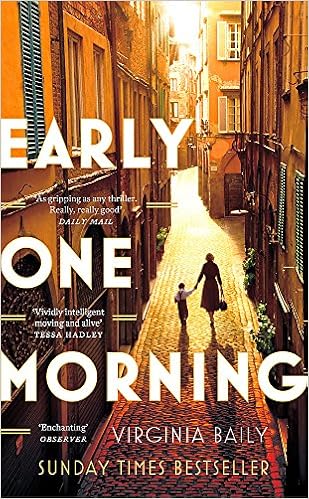
Early One Morning - Virginia Baily
I was attracted to this novel purely by the cover (as I suppose this is meant to happen!) and it has very little about the contents on the b...
-
I was attracted to this novel purely by the cover (as I suppose this is meant to happen!) and it has very little about the contents on the b...
-
Hasn't mother nature given us here in the UK a lovely gift of a month of glorious weather? More like June than April? All I know is ...
-
This is our spare room. It was a glory hole with a bed in it and way too much furniture before the makeover. Now its so nice I wish it was ...